5 Min Read
/Tuscan%20Villa/Charming%20outdoor%20patio%20with%20warm%20lighting%20and%20wooden%20table%20in%20a%20custom%20home%20by%20J%20Bryant%20Boyd%20in%20Georgetown%2c%20TX.jpg?width=960&height=640&name=Charming%20outdoor%20patio%20with%20warm%20lighting%20and%20wooden%20table%20in%20a%20custom%20home%20by%20J%20Bryant%20Boyd%20in%20Georgetown%2c%20TX.jpg)
How much time have you spent in your backyard?
If the answer was not much, it might be worth looking at the condition of your outdoor area. Maybe, like many Georgetown homeowners, your outdoor living space was not given the same level of attention and care as the rest of the home when it was built. But a well-designed outdoor living space can completely change how your home feels day to day. It gives you a place for morning coffee, family dinners, pool weekends, quiet evenings by the fire, and easy entertaining without everyone crowded inside the kitchen.
This guide will look at ways you can create an outdoor area that will easily become your family's favorite place in the home.
- Why Georgetown Outdoor Spaces Often Underperform
- What Luxury Outdoor Living Projects Cost in Georgetown
- Designing for Comfort: Shade, Materials, and Year-Round Use
- Outdoor Kitchens, Fire Features, Pools, and Cabanas
- Privacy, Smart Features, and the Indoor-Outdoor Connection
- Choosing the Right Team for an Architect-Led Project
- Build an Outdoor Space That Works for How You Live
WHY GEORGETOWN OUTDOOR SPACES OFTEN UNDERPERFORM
Most Georgetown backyards don't fail because of bad taste or a tight budget. They fail because the decisions came in the wrong order. A pool gets designed before anyone has thought through how the yard should function, and the finished space ends up feeling assembled rather than designed.
Central Texas doesn't leave much room for that kind of error. Intense summer sun, heavy rain, clay soils, and seasonal freezes mean every decision has consequences. Getting it right starts with the site itself, like wth understanding how the home sits on the lot, where the sun hits throughout the day, where water goes during a heavy rain, and which views to open up or screen. Those factors determine whether the space will be comfortable to actually live in.
Have an experienced residential architect go over these design details and address practical issues like utulies, privacy mand drainage before you start any construction. It will save you time and money later.
WHAT LUXURY OUTDOOR LIVING PROJECTS COST IN GEORGETOWN
Understanding how you'll finance your outdoor living project is just as important as defining its scope, especially for larger architect-led renovations.
| Project Type | Typical Cost Range |
|---|---|
| Covered outdoor kitchen with pergola | $40,000–$90,000 |
| Basic pool | $95,000–$135,000 |
| Pool with spa, rock features, or expanded hardscape | $175,000–$275,000 |
| 20x20 cabana, basic finish | $90,000–$150,000 |
| Cabana with upgraded finishes | $175,000–$200,000 |
A complete outdoor environment, with a pool, spa, hardscape, and privacy work, can reach $300,000 or more in some luxury communities.
Aside from upfront costs, it's useful to think about if you're going to use the space reguarly. An outdoor space that's comfortable ten months out of the year can deliver more value than a larger project that sits empty during peak heat or cool evenings. That kind of usability comes down to design, specifically, how well the space handles Georgetown's climate. And the right architect will deliver the design you need for your project.
For more budget planning resources, access our free Cost Guide.
DESIGNING FOR COMFORT: Shade, Materials, and Year-Round Use
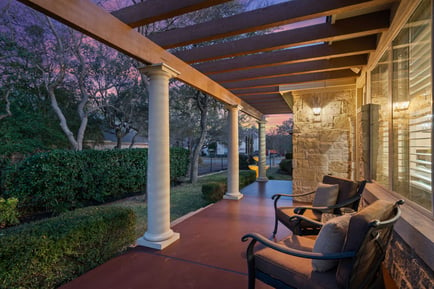 Climate shapes every good decision in this market. Late-afternoon sun, heat radiating off hardscape, and poor airflow can make a well-built patio nearly unusable, and no amount of good-looking material fixes that after the fact. Good design addresses those conditions before aesthetics enter the conversation.
That means studying solar exposure throughout the day, roof depth and orientation, fan placement, surface temperatures, and how to screen low-angle afternoon sun.
Materials that hold up
The same climate that makes comfort a design priority also puts real pressure on materials. Heat, UV exposure, drought, storms, and occasional freezes all affect how finishes age, and the wrong choice shows quickly.
| Material | Why It Works |
|---|---|
| Limestone | Natural fit with Central Texas architecture |
| Concrete pavers | Durable and easier to repair than poured slabs |
| Steel framing | Longer spans, fewer posts, cleaner sightlines |
| Ipe or thermally modified wood | Strong decking option when properly maintained |
Some composite products fade or warp under prolonged sun, and unsealed wood won't last long in the climate here. The right material fits the overall architecture, performs in the climate, and ages well, which matters even more once you're making decisions about what to build.
OUTDOOR KITCHENS, FIRE FEATURES, POOLS, AND CABANAS
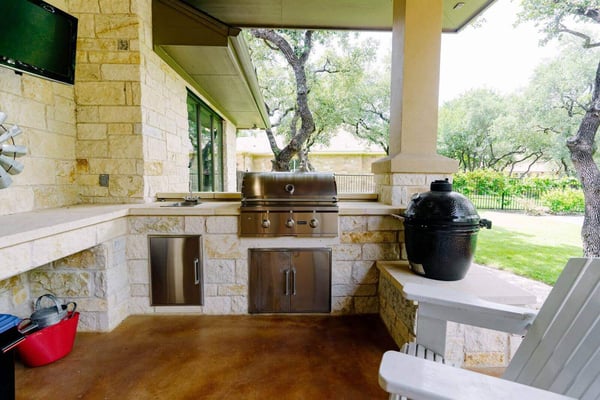 With comfort and materials sorted, you need to shift your focus to how the space actually functions. The best outdoor environments organize around how people gather, not around a single feature, and the individual elements work best when they're considered together.
A good outdoor kitchen keeps the cook in the conversation and cuts down on trips inside. Placement matters as much as the equipment, so the space should be close enough to the indoor kitchen to be convenient, but not so remote it feels like a satellite station.
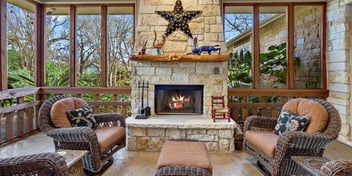
Having a place for a fire gives the space ambiance and usability after dark. A fire pit feels relaxed and social, while a fireplace adds architectural presence and helps define a room.
A cabana works best as a small building rather than a backyard accessory. With a bathroom, sink, mini-split, finished walls, and good lighting, it can serve as a pool house, guest space, fitness studio, or retreat. The roof pitch, exterior materials, window proportions, and trim should all speak to the main house so it looks consistent with the rest of your property.
PRIVACY, SMART FEATURES, and the Indoor-Outdoor Connection
 A space that functions well from a comfort standpoint can still fall short if it doesn't feel private. Many newer Georgetown communities place homes closer together than owners expect, and a yard can have generous square footage and still feel exposed from neighboring windows or second-story views.
Fencing marks the property line but rarely solves the problem on its own. Vertical planting, well-placed trees, and architectural screens tend to do more. Cedar Elm, Monterrey Oak, and Italian Cypress all grow well in Central Texas. A strong lighting plan also pulls attention inward and makes the space feel contained at night.
Smart systems follow the same logic. They work best when you address them at the onset of the design-build process. Early coordination means cleaner wiring, better equipment placement, and lighting zones that make sense, so find a good architect who can walk you through these issues once you start your project.
CHOOSING THE RIGHT TEAM for an architect-led project
Getting all of this right: the comfort, materials, function, privacy, and systems. It depends heavily on who leads the project and when they get involved. For most luxury outdoor projects in Georgetown, that means starting with an architect.
An architect establishes how the outdoor space relates to the home, including the proportions, structure, materials, and design language. In contrast, landscape professionals bring expertise in planting, irrigation, and hardscape. While it's best to have an architect lead the project, it takes a unified team of experts to make everything come together right. So partner with a design-build company that uses this coordinated approach.
When evaluating design-build firms, look for:
- Demonstrated experience with Central Texas climate and soil conditions
- Familiarity with Williamson County drainage requirements
- Work in comparable Georgetown communities like Wolf Ranch or Cimarron Hills
- A process that operates architecture, landscape, and systems under one system
BUILD AN OUTDOOR SPACE THAT WORKS FOR HOW YOU LIVE
The right team can only take a project as far as the brief allows. Before design begins, get clear on how you actually use the space, like how often you entertain, whether the kitchen needs to handle full meals or just weekend grilling, and whether a cabana should include a bathroom and climate control.
Those answers drive the layout, the structures, the materials, and the budget. A family that hosts regularly needs different things than one that wants a quiet evening retreat, so be specific about how you will use the space. And lastly, make design decisions early in the process to avoid delays and added costs. Partner with a local design-build team that has all the professionals you need in one place and has experience building in Georgetown's climate.
Better outdoor living with J. Bryant Boyd
For luxury homes in Georgetown, outdoor living should feel timeless, comfortable, and personal. It should reflect the architecture of your home and how your family wants to live.
At J. Bryant Boyd, outdoor living design is part of how we approach every home. It is considered from the beginning, alongside the architecture, site planning, materials, and construction details that shape the final result.
With over 30 years of experience designing and building custom homes across Central Texas, we understand what holds up in this climate, what resonates in this market, and what it takes to make an outdoor space feel like it genuinely belongs to the house. If you are planning a covered outdoor kitchen, pool environment, cabana, fire feature, or complete resort-style backyard, our team brings an architect-led perspective to every detail.
View our Portfolio to see examples of our work.
Contact Us
Connect with our team to start buidling your outdoor living space.